
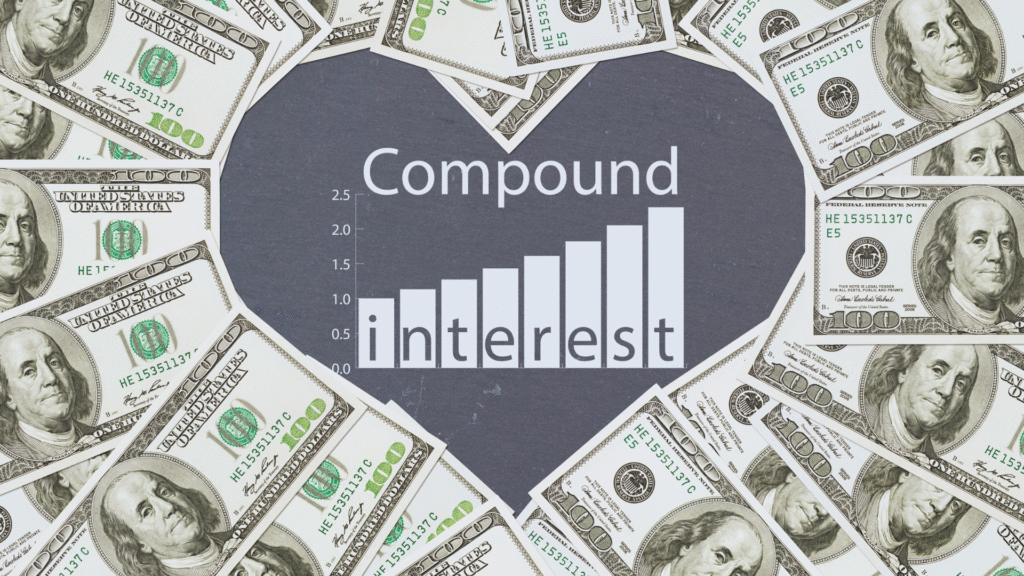
Compound interest powers growth by earning returns on both the original amount invested and the accumulated interest. Over time, this process accelerates wealth creation, turning small, consistent investments into significant gains. This mechanism makes patience and long-term planning essential for maximising returns.
By reinvesting earnings, compound interest allows gains to multiply exponentially rather than linearly. Its true strength lies in time, as even modest rates of return generate substantial growth when left to accumulate over years.
Understanding how compound interest works helps investors make informed decisions about saving and investing. The earlier they start, the greater the benefits become, highlighting the value of long-term financial strategies.
The Mechanics of Compound Interest
Compound interest works by adding interest earned to the original principal, so future interest is calculated on the increased amount. The rate of return, how often interest is added, and the difference from simple interest all shape the growth over time.
Understanding Compound versus Simple Interest
Simple interest is calculated only on the principal amount, meaning the interest does not earn additional interest. For example, with a £1,000 principal at a 5% interest rate for 3 years, simple interest totals £150 (£50 per year).
Compound interest, by contrast, adds earned interest to the principal at specific intervals, so interest earns interest. Using the same £1,000 at 5%, but compounded annually, the total after 3 years grows to around £1,157.63. This happens because each year’s interest is added to the principal before calculating the next year’s interest, increasing the base amount.
The Role of Compounding Frequency
Compounding frequency refers to how often interest is calculated and added to the principal. Common frequencies include annually, semi-annually, quarterly, monthly, or daily.
The more frequent the compounding, the higher the total amount accumulated. For instance, £1,000 at an annual 5% rate compounds to about £1,276 after 5 years if compounded monthly versus £1,276 less accurately with annual compounding (£1,276.28 vs £1,276.28 minor difference but significant over long terms or higher rates).
The compounding frequency affects the effective interest rate, often called the annual percentage yield (APY), which can exceed the nominal interest rate.
The Exponential Growth Effect
Compound interest leads to exponential growth because interest is earned on both the initial principal and on previously accumulated interest.
This growth accelerates over time, especially with higher interest rates and frequent compounding. For example, £1,000 invested at 7% compounded annually grows to around £1,967 after 10 years, nearly doubling, while simple interest gives only £700 interest.
The exponential effect becomes more pronounced in longer-term investments. The total amount can significantly exceed the original principal due to this cumulative effect.
Factors Influencing Long-Term Compound Gains
Compound growth depends on several key elements that drive investment returns over time. These include the length of the investment period, the consistency of contributions, and how profits such as dividends are handled.
Impact of Time Horizon on Wealth
The length of time an investment remains untouched is critical. The longer the time horizon, the more opportunity compound interest has to multiply gains exponentially. Even small initial amounts can grow substantially over decades due to repeated reinvestment of returns.
Shorter time frames limit growth because earnings have fewer cycles to compound. Investments held for 20 or 30 years will typically generate far greater wealth than those held for 5 years.
Importance of Early and Regular Contributions
Starting contributions early maximises wealth accumulation by extending the compounding period. Regular contributions add new capital, increasing the base on which interest compounds. This steady input accelerates growth beyond relying only on initial investments.
For example, investing a fixed amount monthly can yield significantly higher long-term returns than a one-off lump sum. Consistency in adding funds also reduces the risk of poor timing since average costs balance out over time.
Effect of Reinvesting Dividends and Earnings
Reinvesting dividends and earnings fuels the compounding effect by continuously increasing the investment principal. Instead of taking payouts as cash, dividends are bought back into the portfolio to buy more shares, which generate further dividends.
This cycle accelerates the growth rate, especially in dividend-paying stocks or funds. Reinvested earnings increase total investment size without additional out-of-pocket costs, boosting long-term wealth through cumulative growth.
Practical Applications and Strategies
Effective use of compound interest involves selecting suitable investments, managing risks, and maintaining purchasing power. Understanding how different vehicles work and balancing your portfolio are essential steps to long-term growth.
Compound Interest in Different Investment Vehicles
Compound interest operates distinctly across various investment options. Savings accounts offer lower returns but provide safety and liquidity. Typically, interest compounds daily or monthly, making them suitable for short-term goals.
Certificates of deposit (CDs) lock funds for fixed periods, usually offering higher interest rates than savings accounts. Interest often compounds monthly or quarterly. CDs reduce risk but limit access to funds.
Stocks rarely pay compound interest directly but generate returns from dividends and capital gains. Reinvesting dividends allows the effect of compounding on growth.
Bonds provide periodic interest payments that can be reinvested. The compound effect depends on reinvestment strategy and bond maturity.
Managing Risk and Market Volatility
Market fluctuations can impact compound interest returns, especially in stocks and bonds. Managing risk involves assessing risk tolerance and adjusting exposure to volatile markets.
Using a combination of low-risk assets like CDs and savings accounts can stabilise returns. Periodic portfolio reviews ensure alignment with financial goals and personal risk appetite.
A disciplined approach to reinvest dividends and interest payments helps harness compounding despite short-term market downturns.
Portfolio Diversification for Long-Term Growth
Diversification balances growth and risk by spreading investments across stocks, bonds, and cash equivalents. It reduces the volatility’s impact on the investment portfolio.
A diversified portfolio might include high-growth stocks, stable bonds, CDs, and savings accounts. Each contributes differently to compounding returns and risk management.
By mixing asset classes, investors benefit from market upswings while protecting against downturns. This steady growth supports sustained compound interest over time.
Preserving Purchasing Power Over Time
Inflation erodes the value of money, affecting real returns on investments. To preserve purchasing power, returns must outpace inflation.
Stocks historically offer higher growth rates, helping counteract inflation’s effects. Bonds and CDs may lag but provide stability.
Choosing investments with returns exceeding inflation ensures compounded gains translate into increased buying power. Reinvesting earnings accelerates this effect, maintaining wealth over time.